
Attorney General signals potential legal action against MBTA Non-Compliant towns like Tewksbury.
BOSTON — In a recent legal advisory, the Massachusetts Attorney General’s Office announced that while legal enforcement of the MBTA Communities Act remains on hold for now, non-compliant cities and towns like Tewksbury could face legal action as early as January 1st, 2026.
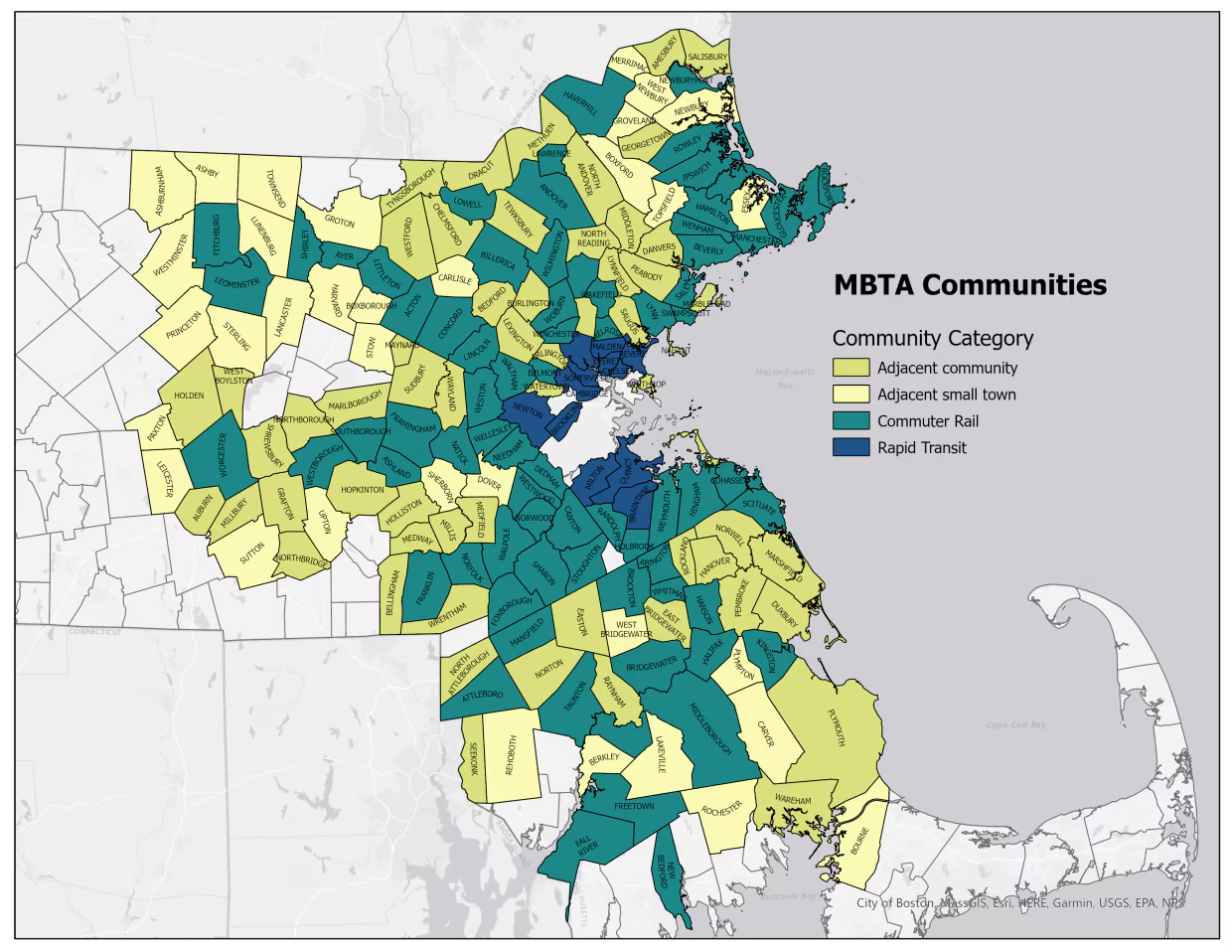
Earlier this year, the Executive Office of Housing and Livable Communities (EOHLC) implemented emergency regulations granting communities that missed their 2023 or 2024 compliance deadlines an extended window to meet requirements – July 14th, 2025. This grace period applied to “Adjacent Communities,” a classification under the law that includes Tewksbury.
Tewksbury has now officially missed the extended deadline, shifting its status of interim compliance to non-compliance. On May 8th, 2025, town voters rejected Article 41, a zoning bylaw amendment designed to bring the town into compliance. Compounding the issue, the Planning Board opted not to include the required MBTA Communities overlay zoning on the 2025 Annual Town Meeting warrant, effectively halting further progress.
Non-compliant towns like Tewksbury are now subject to significant consequences, including the loss of eligibility for key state infrastructure funding. Programs such as MassWorks and HousingWorks—which provide support for transportation, water, sewer, and housing-related projects—are no longer accessible to municipalities that fail to comply.
Without prompt action to implement the required zoning reforms, non-compliant communities will face civil enforcement or legal action initiated by the state as early as 2026.
In her advisory, Attorney General Andrea Campbell made it clear that towns showing no movement toward compliance could be subject to earlier legal intervention:
“By contrast, where a community has demonstrated that it will achieve compliance only when ordered to do so by a court, and the pertinent deadline has passed, the AGO may bring a civil enforcement action at any time.”
In a related legal development, a Massachusetts Superior Court ruling in June reinforced the legality of the MBTA Communities Act, rejecting legal challenges from nine towns that argued the law was an “unfunded mandate”. The court dismissed those claims, reaffirming the state’s authority to enforce the statute.
The full ‘Second Advisory Concerning Enforcement of the MBTA Communities Zoning Law’ can be found here.
Kari Weinstein


Kari studied Journalism and Advertising at Boston University and lived in Boston for 10 years, most recently moving to Tewksbury in early 2024. She has experience writing and producing content for radio and television.


Be First to Comment