
In Milton MBTA Communities Act lawsuit, the Supreme Judicial Court rules that AG has the authority to sue cities and towns not in compliance — including Tewksbury.
In February 2024, residents of Milton, a town with four MBTA stations along the Mattapan High-Speed Line, rejected a proposed zoning plan designed to meet the requirements of the 2021 MBTA Communities Act and sued, claiming that the state’s recourse was limited to withholding a set of grants that were listed explicitly in the law.
This Wednesday, the Supreme Judicial Court ruled against Milton, affirming that Attorney General Andrea Campbell has the authority to sue municipalities to force compliance with the MBTA Communities Act, commonly known as MBTA-C, with the caveat that the state needs to rework rezoning guidelines.
You can read the unanimous SJC ruling here.
“The state’s highest court has made it clear that communities affected by the law must permit additional, responsible development—and that compliance with the law is mandatory, not optional,” said AG Campbell in response to the ruling.
The court noted that communities failing to comply with the law remain ineligible for funding from programs such as the Housing Choice Initiative, the Local Capital Projects Fund, the MassWorks Infrastructure program, and the HousingWorks Infrastructure program.
While the town of Milton argued that these funding penalties were the only consequences of non-compliance, the court ruling clarified that these are not the sole repercussions, as zoning requirements will be enforced. Chief Justice Budd wrote that allowing fiscal penalties to be the only consequence would “thwart the Legislature’s purpose by converting a legislative mandate into a matter of fiscal choice.” The court concluded that the penalties outlined in the act do not exclude the equitable relief that the Attorney General is empowered to seek under her broad statutory authority.
The MBTA Communities Act was passed under the Baker administration to tackle the ongoing housing crisis in the Commonwealth by requiring cities and towns that benefit from access to MBTA services to implement zoning that designates at least one district for multifamily housing “by right” near their MBTA facilities. It does not require that any housing be built, only that the zoning be in place.
Chapter 40A defines an “MBTA community” as consisting of the 14 cities and towns that originally hosted MBTA service, the 51 cities and towns that joined later, and other “served communities” that border a city or town with MBTA service. In total, 177 communities are subject to the new requirements. This includes 12 rapid transit communities, 72 commuter rail communities, 58 adjacent communities, and 35 adjacent small towns.
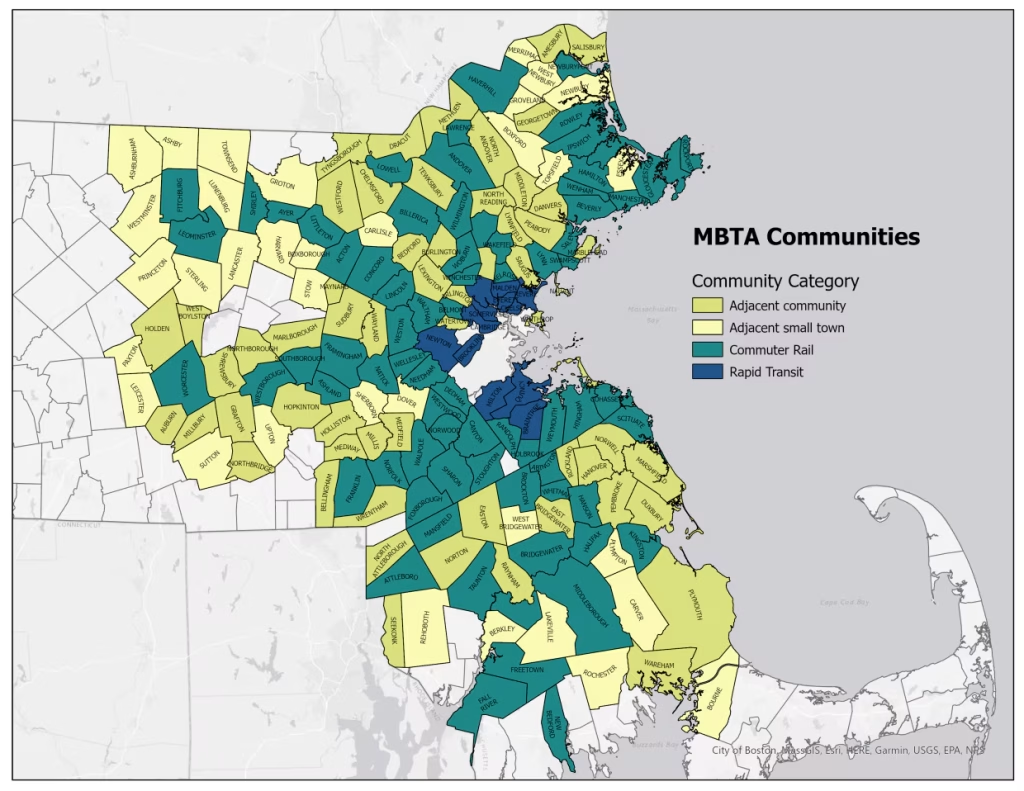
Each community category also has a specific deadline for compliance with the law. Rapid transit communities had a deadline of December 31, 2023. Commuter rail and adjacent communities had until December 31, 2024, while adjacent small towns have until December 31, 2025.
As of January 2025, 130 towns have passed their end-of-2024 deadline to approve new zoning rules. There are 31 communities considered non-compliant with the law, including Tewksbury, which voted to reject Article 41 on May 8, 2024, preventing the town from meeting the compliance deadline.
While the SJC determined that the Attorney General has the authority to enforce 3A and its related guidelines, the Executive Office of Housing and Livable Communities’ (EOHCL) current guidelines were found not to have been promulgated in accordance with the Administrative Procedures Act (APA). To fix procedural issues, the Healey administration said in a statement that it would issue emergency guidelines by week’s end, as authorized:
“If the agency finds that immediate adoption, amendment, or repeal of a regulation is necessary for the preservation of the public health, safety, or general welfare and that observance of the requirements of notice and a public hearing would be contrary to the public interests, the agency may dispense with such requirements and adopt, amend or repeal the regulation as an emergency regulation. The agency’s finding and a brief statement of the reasons for its finding shall be incorporated in the emergency regulation as filed with the state secretary under section five. An emergency regulation shall not remain in effect for longer than three months unless during that time the agency gives notice and holds a public hearing as required in this section, and files notice of compliance with the state secretary.” Chapter 30A Section 2
Prior to Tewksbury’s May Town Meeting, where residents rejected proposed zoning that would have brought the town in compliance with the MBTA Communities Act, the Select Board and Planning Board submitted an interim plan on January 27, 2023, and received state approval on March 3, 2023.
You can read the Tewksbury Carnation coverage of the May Town Meeting here.
The Planning Board advanced two sites for pre-adoption review, with the Select Board ultimately approving one, known as “Main Street A.” The proposed Bylaw and map were reviewed by the Executive Office of Housing and Livable Communities and the Attorney General’s Office, both with positive outcomes.
The proposed district was located at the southern end of Route 38, stretching along both sides of Main Street. It began at Al Fresca, running through Heathbrook Plaza and Oakdale Plaza, and ended at the Shawsheen/Main Street intersection.
The dimensional requirements for the district were derived from the existing zoning bylaw or remain unchanged from the underlying Mixed-Use Business District. This new zoning district was to be implemented as an overlay, meaning the current requirements and allowed uses of the Mixed-Use Business District remain intact. The overlay district would have allowed for additional possible uses, without affecting the ongoing operation of existing businesses. It was an enhancement to, rather than a replacement of, the current zoning framework.
Their goal was to concentrate development in an area already slated for revitalization, to avoid unnecessary overdevelopment in other parts of the town.
Depending on the timing and content of the new guidelines released by EOHLC, the Attorney General and the town will decide whether the pre-approved zoning can still be utilized or if a new plan will need to be implemented.
For now, Tewksbury waits…
Kari Weinstein

Kari studied Journalism and Advertising at Boston University and lived in Boston for 10 years, most recently moving to Tewksbury in early 2024. She has experience writing and producing content for radio and television.


After the passing of the new guidelines and procedure at beacon hill, then pass legal muster, any continued litigation, public hearings, Annual and Special Town Meetings, approvals by non compliant towns and cities it will be 2026. Then hopefully someone or group in each town will bring an Article with a one year moratorium on town or city building to their Annual Town Meeting. Followed by recruiting challengers to every rep that voted for this piece of crap and vote them and the Governor out of office.